Math Refresher: Complex Numbers
Quantum amplitudes carry a phase, an angle that affects how amplitudes combine. Complex numbers are the language for that angle. This page defines them and the one formula the rest of the site relies on most: Euler's formula.
1. Complex numbers
A complex number pairs two real numbers,
where . The number is the real part and the imaginary part. We add and multiply by the usual rules, treating as an object whose square is .
The complex conjugate flips the sign of the imaginary part, . Multiplying a number by its conjugate gives a nonnegative real number:
We call the magnitude of . In quantum mechanics, a probability density is built this way: on First Quantization.
2. The complex plane and Euler's formula
Plot horizontally and vertically. Then is a point in a plane, and is its distance from the origin. The direction of that point from the origin is its phase, an angle .
A point at distance from the origin sits on the unit circle. The coordinates of such a point are , so
This is Euler's formula. It connects the angle to the exponential , and it is the single most-used identity on this site. In particular and .
Because , every number has magnitude exactly . A complex number of general magnitude and phase is .
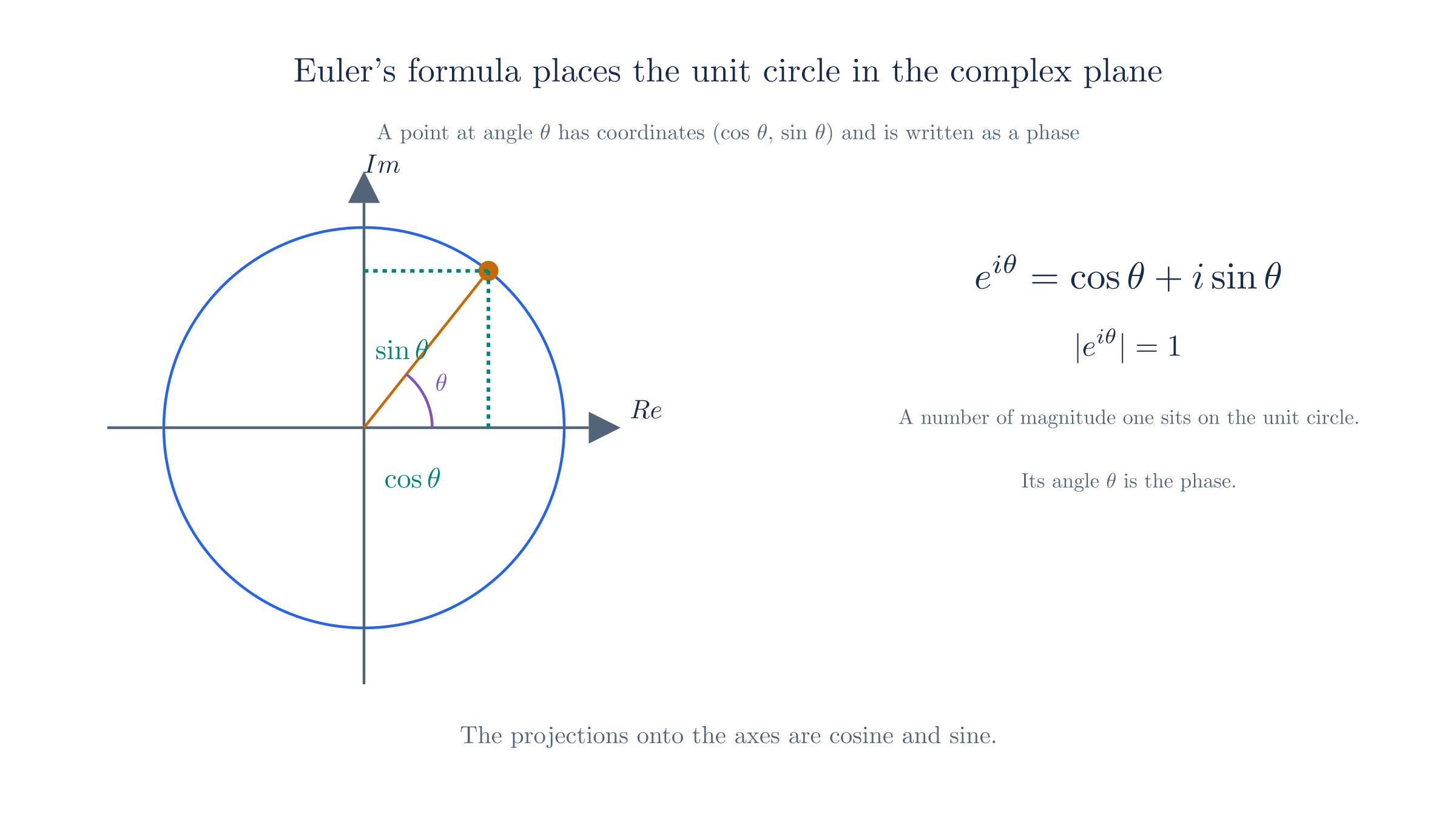
A point at angle θ on the unit circle has coordinates (cos θ, sin θ), so it is written as the phase e^{iθ}.
3. Multiplying adds phases
Multiplying two numbers multiplies their magnitudes and adds their phases:
This follows from Euler's formula and the usual addition rules for sine and cosine. Two consequences matter throughout the site:
- Multiplying by rotates a point by the angle without changing its magnitude. This is the phase rotation used for the U(1) symmetry of QED.
- Adding two complex numbers of similar phase reinforces them, while adding numbers of opposite phase cancels them. This is the interference between amplitudes.
The conjugate of is , the same rotation in the opposite direction.
4. Waves and the Fourier transform
A plane wave writes an oscillation as a complex exponential,
The real part is a cosine wave; the complex form is easier to differentiate because the derivative of is . This wave appears first on Relativistic QM and drives every field expansion afterward.
A general function can be written as a sum (or integral) of such waves with different momenta. Reconstructing the function from its momentum components is the Fourier transform. It is the step that connects the position and momentum representations in First Quantization and that decomposes a field into momentum modes in Field Quantization. Roughly: a sharply localized position wave is a broad sum of momentum waves, and vice versa, which is the mathematical content of the uncertainty relation.
5. Conjugation and the adjoint
In quantum mechanics, complex conjugation of a number becomes the adjoint (†) of an operator. Replacing each amplitude by its conjugate is the step that, after quantization, becomes on Field Quantization. The two operations play the same bookkeeping role: they reverse the sign of every phase and swap creation with annihilation.
Previous: Calculus
Next: Linear Algebra