Math Refresher: Groups and Symmetry
Gauge theories — QED and the weak interaction — are built from symmetry transformations. This page introduces the vocabulary: what a group is, what a generator is, and why some groups are called non-Abelian. It covers the two groups the site actually uses, U(1) and SU(2).
1. What a group is
A group is a set of transformations together with a rule for combining them. Four properties hold:
- Closure: combining two transformations gives another transformation in the set.
- Identity: there is a transformation that changes nothing.
- Inverse: every transformation can be undone by another in the set.
- Associativity: the order of grouping does not matter, .
Rotations of a plane form a group: two rotations combine into one, the zero rotation is the identity, and every rotation has an opposite. What makes a group interesting here is not this bookkeeping but the structure of the transformations themselves.
2. U(1) and phases
Multiplying a complex number by , with a real angle, rotates it by while preserving its magnitude. The set of all such factors forms the group U(1). Each factor is a unitary matrix — a complex number of magnitude one — so the name reads "unitary, dimension one."
U(1) is the symmetry of QED: multiplying the electron field by a common phase leaves every probability unchanged, because the phase cancels against its conjugate.
3. Generators
A continuous group has transformations arbitrarily close to the identity. Near the identity, any transformation is for small , where is a fixed object called a generator. The generator produces the infinitesimal change; repeating (exponentiating) it builds a finite transformation,
The factor keeps the transformation on the unit circle: has magnitude one for every real , so the transformation preserves lengths.
For U(1), is just the number , so the exponential reproduces . To see what a generator does, apply an infinitesimal transformation and keep the first-order term. For U(1) this acts on a complex number as
a small step sideways, along the tangent to the circle. The generator fixes that tangent direction — the arrow at the identity in the diagram below — and the exponential walks along it through the full angle. For larger groups the generators are matrices, and the same logic applies component by component, as used for spinors on The Dirac Equation.
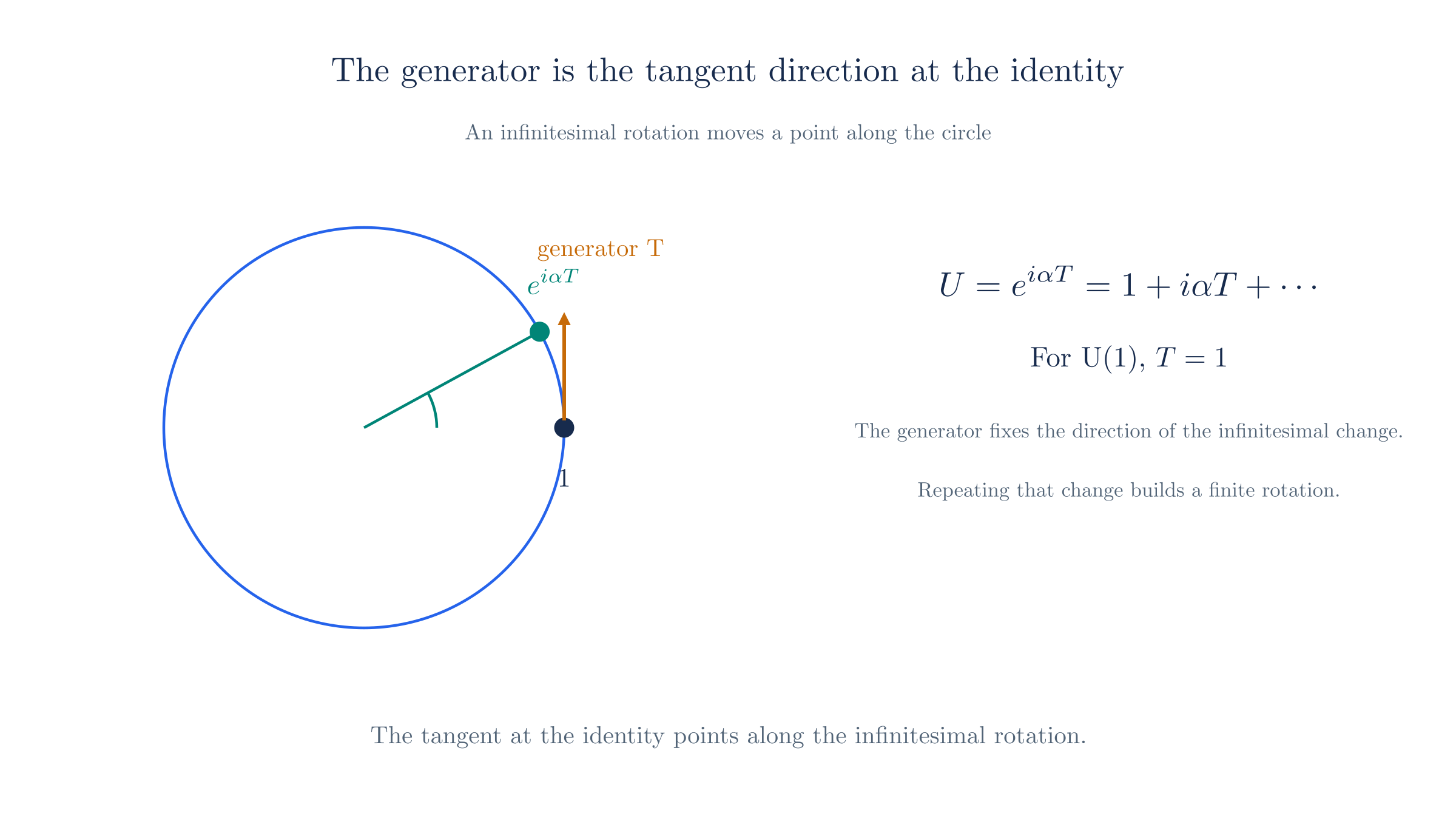
A rotation group is a circle; the tangent at the identity is the generator that fixes the direction of the infinitesimal change.
4. SU(2) and the Pauli matrices
SU(2) is the group of unitary matrices with determinant . Its three generators are the Pauli matrices divided by two:
These are the same Pauli matrices that describe spin, but on the weak-interaction page they act on a doublet of particle species (an electron and its neutrino), not on spatial spin. The superscripts label the three generators.
To see one at work, take and a small angle . An infinitesimal SU(2) transformation is
and it acts on a two-component vector — a doublet — by mixing its entries:
Each generator reshuffles the two entries in a different way: mixes them with a real off-diagonal, with an imaginary one, and rescales the two entries with opposite signs without mixing them. Exponentiating a generator builds the corresponding finite rotation of the doublet.
5. Non-Abelian and structure constants
In a group like U(1), the order of two transformations does not matter: multiplying two phases gives the same product either way. Such a group is Abelian. In SU(2), order matters, because its generator matrices do not commute. The generators obey
where equals for and its even permutations, for odd permutations, and when two indices repeat. A group whose generators fail to commute is non-Abelian.
This single fact changes the physics. The field strength of a non-Abelian gauge theory gains an extra term — on Weak Interaction — which makes the gauge bosons interact directly with one another, something the photon never does. The names Yang–Mills theory and structure constants both refer to this construction: a gauge theory built from a non-Abelian group, and the numbers that fix how its generators combine.
Previous: Index Notation and Tensors